
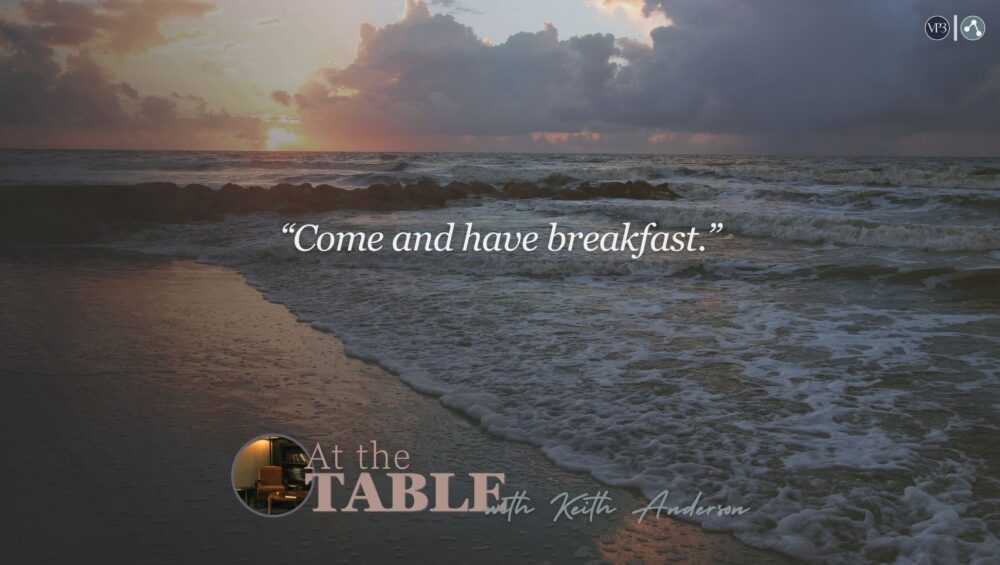
Breakfast on the Beach

Living the Resurrection

Resurrection did not begin with a sermon. After the shock of the empty tomb, after fear and disbelief, after locked doors and unfinished conversations, Jesus Christ does something so ordinary it is almost anticlimactic.

He makes breakfast.

Bread.
Fish.
A charcoal fire.
Morning light.
Tired bodies.
Hungry souls.

This is how resurrection announces itself—not as spectacle, but as presence.

“The surprising thing about biblical spirituality is that God is present in the ordinary, daily, common, and concrete realities of life.”1

“God is forming us into a new people. And the place of that formation is in the small moments of today.”2

Resurrection doesn’t pull us out of the world; it restores us to it. And here, on the beach, resurrection smells like smoke and fish and fishing nets. What we are invited into, as were these disciples, is resurrection breakfast—the most dramatic event in human history captured in quiet, small, and ordinary things. Read More

They Stayed

On Good Friday, the gospels ask us to notice who remained. Not the crowds who shouted. Not the disciples who promised loyalty and then scattered into the shadows. The ones who stayed were the women—standing at a distance, close enough to see, close enough to grieve, close enough to be marked forever by what they witnessed.

John’s gospel writes with almost startling simplicity: “Standing near the cross of Jesus were his mother… and Mary Magdalene.” 1 Matthew and Mark quietly confirm it: when the others scattered, these women stayed.2 Good Friday is not only about Jesus’ suffering, but it is also about the courage of presence. It is also about the courage of those who refused to look away.

Read More

The Legend of Judas

I’ve never met someone named Judas. John, Peter, Matthew, Thomas, Levi—these are people whom I know. But never Judas. His story is an enigma, an outright confusing puzzle, not because of what he did, but because Jesus chose to invite him to follow. In Luke’s list of disciples, he names him “Judas Iscariot, who became a traitor” (Luke 6:16).  Not who was a traitor—but who became one. Jesus chose him before the ending was known, before betrayal hardened into history.


Jesus didn’t gather admirers or spectators. He called followers: people who would walk with him, walk alongside him, and walk forward into the mission of God. Which raises a troubling question: Why then would Jesus choose one who would “become a traitor?” Perhaps this is the wrong question because we could say of Thomas: “Why would Jesus choose one who would become a doubter?”  Of Peter: Why would Jesus choose one who would become a denier?”  Lent presses us to notice not only those who fail—in truth, almost all the gospel stories show us that all the disciples failed, misunderstood, or fell short one way or another. Read More

Jesus Sees Peter

We all want to be seen by Jesus, the very Son of God. We often seek a feeling of His presence, a longing to sense Him beside us and with us. The writers of the Psalms often cried out for God to be close, to not turn a deaf ear to them, or for God’s glory to thunder forth, asking God with words like these: “Do not hide your face from me.”[1]

This morning, I started my day by asking God that I might “sense you every hour and make this day a prayer.”

Just hours before he held the bread and cup of the Passover feast, Jesus refocused the eyes of the disciples’ faith to see more than unleavened bread and wine—more even than the memory of the exodus from slavery in Egypt. He looked each of them in the eye, gave them the spiritual food, and said, “I give you this bread, this wine. I ask you to do this often to remember not only our historic covenant, but the covenant fulfilled—the new covenant in my blood.”

When God makes a covenant with people, God is true to God’s word. Of the many terms we might use to describe God, these two are formative: God is covenant-maker, and God is covenant-keeper. Read More

Nicodemus: The Long Way Around Faith

He came at night.

Not because he was wicked.
Not because he was hostile.
But because he was careful.

Nicodemus was a serious man—trained in Torah, disciplined in lifestyle, respected as a teacher of the law.  He knew the scriptures by heart. He had practiced faith through repetition and ritual. He had devoted his life to learning what God had said and guarding what God had given.

And yet, something in Jesus unsettled him.

“Rabbi, we know that you are a teacher who has come from God…” —John 3:2

Notice the language: we know. Nicodemus spoke for a class of people—teachers, leaders, the spiritually accomplished. His faith was accurate, informed, orthodox. He admired Jesus. He even defended him later in John 7:50–51. And after the crucifixion, he helped care for Jesus’ body (John 19:39).

Nicodemus always seemed to be near Jesus, in proximity to him, whether in the city streets or in a secret room one-to-one, late at night. He always seemed to be near him, but never quite with him. Like many of us, he knew a great deal about him. He had good information and great curiosity, but he lacked trust in Jesus’ words and ways. Read More

Dayenu: A Spiritual Practice of Gratitude

 A devotional reflection on Isaiah 43

Sung or chanted each year around Jewish Passover tables, Dayenu (pronounced die-YAY-noo or DIE-yenu) carries a depth of spiritual wisdom many Christians might miss. It means simply: It would have been enough.

  • If God had only brought us out of Egypt, but not split the sea: Dayenu.
  • If God had only split the sea, but not let us through on dry ground: Dayenu.
  • If God had only let us through, but not sustained us in the wilderness: Dayenu.

This litany, sung with joy, rising rhythm, and often laughter, is more than a historical rehearsal. It is a spiritual declaration. We live not by entitlement, but by grace. And grace is Dayenu, always more than enough. Read More

A Lenten Rule of Life

Practices for Paying Attention to God

Through The Journey and A Way of Life processes, many have experienced what it’s like to be given a template for our energy toward God to wrap itself around—a shared rhythm of weekly gatherings, Scripture, prayer, reflection, and honest conversation. Over time, these practices become a kind of scaffolding for our longings: a way to channel our desire to know God, live attentively, and participate more faithfully in what God is already doing in our lives and communities.

As Dallas Willard once described it, this kind of formation becomes a curriculum for Christlikeness—not something rigid, but a simple structure that supports who we are becoming.

Spiritual director Adele Ahlberg Calhoun reminds us that a rule of life is “a simple statement of the regular rhythms we choose in order to present our bodies to God as our ‘spiritual act of worship.’” These rhythms aren’t burdensome checklists. They’re realistic, life-giving practices that keep our lives from drifting into unintended chaos and help us partner with God in the transformation only He can bring.

With Lent inviting us again to slow down and pay attention, Keith Anderson offers a thoughtful reflection on crafting a Lenten rule of life—one shaped not by striving, but by fasting, prayer, and generosity as gentle ways of becoming more present to God. Read More

Ashes to Go

Seeing with Fresh Eyes

It was an early Wednesday morning, and I was hurrying—almost running—to catch the ferry from Bainbridge Island to Seattle. The terminal felt especially busy that day, crowded with people moving at practiced speed, the way overachievers do, intent on finding their preferred seat or joining their familiar cluster of friends for the thirty-five-minute crossing over the eight miles of Puget Sound.


I wasn’t paying attention to anyone. I was distracted—preoccupied in the way a graduate school president often is—lost in my own thoughts, unaware that this was not just any Wednesday. This was a holy day in the life of the Church. 


As I reached the edge of the terminal building, I saw him.


There stood my pastor—our vicar, Father Dennis—vested as he would later be that afternoon in the sanctuary of St. Stephen’s Episcopal Church. I had never seen him on the ferry commute before. Then I noticed the sign placed deliberately at his small station near the flow of foot traffic: “Ashes to go.”

Read More

Easter Sunday

I’ve been to Jerusalem where I saw what some traditions believe was the place of Jesus’ birth and nearby to where they think he was buried. Lots of gold, jewels, silver, and a certain kind of beauty. But I’ve also seen places “off the beaten path” where others imagined birth and burial: I am moved by those places. No gold, jewels, silver, or “glory,”  just terra firma under our feet. We know the stable pictures of the Nativity and we can imagine a huge round stone in front of a cave-like tomb on Good Friday and Easter Sunday. Read More

Crucifixion Friday

One Disciple on Crucifixion Friday: A Soliloquy

I wasn’t there—when the sky cracked open and the earth groaned beneath the weight of what it witnessed that violent day. I wasn’t there. I ran. I hid. I let fear throttle the breath from my chest while the one I swore to follow was nailed to splintered wood like an animal, his body a ragged ruin of torn flesh and exposed bone. Say what you will about loyalty—I lost mine somewhere between the first lash of the whip and the moment they rammed that cursed thorn crown onto his head. I should have been there. But I wasn’t there. Fear, not faith, took control of my steps. Read More