

They will call me Doubting Thomas or just plain Doubter.
I already know that.
History likes its shorthand, and faith prefers its heroes uncomplicated.
But if I am honest—if I speak now without defending myself—I was never trying to be difficult. I was trying to be faithful and honest.
I had already followed him. I gave up my former life because I really had no choice. What he taught and what he did compelled me, is there a better word? Criticize me if you must, but I left everything behind to join a ragtag school of people I did not know until I met him. Jesus showed up, I turned from what I knew to something I had to know, and I turned toward something it would take a lifetime to comprehend—or perhaps even longer. To be honest, many who call me the doubter never seem ready to give up anything to follow. They prefer the familiar, the known, but I left my former life behind. I did not lose, I am not saying I did. My mind was not on what I was leaving but what I was joining.
That matters more than most people will remember.
- I left what I knew.
- I walked the roads.
- I struggled to understand this kingdom of God he spoke about.
- I wrestled with my own weariness as he sent us out to teach, heal, and cast out demons.
I watched bodies heal and tremble when my own hands became agents of healing, my own voice the echo of redemption and forgiveness, my own touch a welcomed gift all across our land. - I stood with him when others calculated the risk.
When he said we were going back into danger, I said, “Let us also go, that we may die with him.”1 That declaration was not doubt. That declaration was the truest expression of my faithfulness. That was not sentiment or cliche but the intention of my very soul.
So, I ask myself—and I ask you, who will read my words:
Did I lack faith? Or did I refuse illusion?
I had seen messiahs come and go.
I had seen hope weaponized before.
I had seen messiahs crushed by empire.
I watched as many started out with the excitement of the new, the revolutionary, the radical only to leave when resistance came; when those in power sought to stifle, crush and silence. I had seen how longing can masquerade as belief.
But when the cross came—the awful, brutal, violent, and crushing crucifixion—something in me died as I knew a truth I could not deny: Rome did not execute an idea. Rome executed a body. Rome and the Jewish leaders put to death this one I loved, this one I learned to trust.
Days later, some of our own said, “We have seen the Lord,” But I knew what everyone knew—Jesus was crucified; the cross was no symbol but a means of execution. No one returned to walk among the living after this death. We were told his hands were pierced, and a spear was shoved violently into his side to ensure our teacher would teach no more. And yet Mary and the others among us said, “We have seen the Lord.” I could not borrow their certainty.
I ask you this, as I asked myself then:
Is faith still faith if it refuses to look at wounds? Or does it become denial dressed in devotion?
I did not ask for arguments.
I did not ask for theology.
I asked for flesh.
Hands.
Scars.
A side pierced open.
I needed to know that resurrection had not erased suffering—only redeemed it.
I ask again, for your sake:
Is faith that demands contact a failure of belief—or a refusal to believe in ghosts?
When he came—when he stood among us—he did not shame me. He did not say, “How dare you?” He said, “Come closer.”
And still, even now, I feel the weight of his words: “Do not doubt, but believe… Blessed are those who have not seen and yet have come to believe.”2
While I waited, others were already practicing resurrection life.
While I inspected, others entrusted themselves.
While I stayed behind locked doors, the world was already opening.
I did not mean to posture or perform, but I could not soften my questions for the sake of others. “Unless I see the mark of the nails in his hands, put my finger in the mark of the nails and my hand inside, I will not believe.”3
He asked me to touch the scarred and broken hands, the sword-pierced side. I could not know then what the others knew first: What he promised us before his death now stood before in resurrected life. I confess to you now, you who read my words centuries later: do not mistake my honesty for failure. Whatever else, I refused pretense. Whatever else, I refused faith borrowed from others. I brought my questions to this one who stood before us all.
I could not pretend a faith I did not have. I could not say “Alleluia” while my heart was broken by grief, loss, and sorrow.
And when I finally spoke, I did not argue. I surrendered. I spoke what I had declared those years as his apprentice: “My Lord and my God.”4
Not because my questions vanished—but because my resistance did.
Jesus does not ask you to silence your doubts. But neither does he invite you to live inside them.
He still stands before locked rooms.
He still meets guarded hearts.
He still says, “Come closer.”
The question I leave you with is not whether doubt is allowed. It is this: When truth stands before you, too, in the resurrected presence of Jesus, will you trust or will you keep asking for more?
Jesus said to my shock, “Put your finger here and see my hands. Reach out your hand and put it into my side. Do not doubt, but believe.” What I heard him say to me was, “Thomas, you spent three years with me. You heard me teach. You followed me. But you are now defiant in your denial of the truth standing before you. I told you I would be with you in death as in life. I showed you my broken body in the Sacrament of the Communion meal.”
His words, I know now, were not a ploy to test me. His words were not rhetorical. Jesus invited me to do what he demanded. Go ahead, Thomas. Put your finger here. Reach out your hand there. And I answered him. In the deepest confession of my soul, my Lord and my God. Because I had been paralyzed in my inability to trust the truth of Jesus’ teachings.
Jesus gave me precisely what I asked. Jesus literally offered himself to me, and I literally offered myself to Jesus. With an uncompromising declaration of my heart, mind, soul, and future.
My Lord and my God.
Practice
Read John 20 again and honestly ask yourself:
- Would my response be different than that of Thomas’?
- What “touch” do I require of Jesus in exchange for my obedience?
- What question(s) would I have had if I had stood in that room with the disciples?
Then write your own declaration of faith. Post it somewhere you will see it every day.
___________________________
This spring, Keith Anderson and Rob Loane are creating space for leaders to tend the inner life together in A Leader’s Journey in a Fractured World. You can read more and register here.
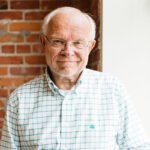
Keith Anderson, D.Min., is a Faculty Associate for Spirituality and Vocation at VantagePoint3 and President Emeritus of Seattle School of Theology and Psychology. He is the author of several books, including his most recent: On Holy Ground: Your Story of Identity, Belonging and Sacred Purpose (Wipf & Stock, 2024). His other works include Reading Your Life’s Story (IVP, 2016), A Spirituality of Listening (IVP, 2016), and Spiritual Mentoring (IVP, 1999). In his writing, teaching, and mentoring, Keith seeks to set a table for people looking to enter the “amazing inner sanctuary of the soul” in the most ordinary and extraordinary moments of life.
1 John 11:16 NRSV
2 John 20: 27b, 29
3 John 20:25b
4 John 20:28