
A Soliloquy
It has been years now, but I can still hear the knock.
That single, hurried knock upon my door—
the sound of it still splits the silence of my sleep.
The city was crowded that night, Bethlehem bursting like a wineskin.
Every corner filled, every room claimed by those come to be counted.
And me? I was proud of it.
A full house means full hands, full pockets, a full purse.
As an innkeeper—well, I thought myself fortunate.
But then came the knock.
I remember opening the door to see a man, dusty and travel-worn,
his arm around a young woman—
her face pale, her eyes weary, and her belly swollen with child.
He asked, in a voice both desperate and gentle,
“Please. A place to stay. She’s with child.”
And I looked—
I looked past him,
past her,
past the labor of love unfolding before my very eyes—
and I saw only inconvenience.
There is no room, I said.
No room.
I had said those words a dozen times that night,
but this time, they stuck in my throat.
No room. A census meant hundreds came to our small town to register as required by our Roman oppressors and our Jewish leadership.
But I felt something within, more visceral and yet more spiritual: there was no room in our Inn, but my perception of this young couple, soon to be a family, stirred something about room within my own heart. It wouldn’t be that hard to say no, cast them aside, and send them on their way, but….what was it?
I caught a glimpse of an inner impulse, an instinct perhaps. I did not know then that His Majesty, our future king, our Messiah, would sleep in our stable. I only learned about this one named Jesus when his infancy matured into adulthood. I didn’t know then, but only later:
“For a period ever so brief, the doors to the throne room were open and God came near. His Majesty was seen. Heaven touched the earth and, as a result, earth can know heaven.”[1]
Late that night, in a moment that surprised me and all of my household, I pointed them toward the stable—
a crude shelter,
dark and smelling of animals and hay.
“Just there,” I said, “it’s all I have. There is no room.”
And that was it.
Just a moment.
A moment I did not recognize as holy until years later.
A moment I hurried past.
Later that night, when the city finally slept,
I stepped outside to breathe in the cool air.
And from the hillside came a sound—
a sound that didn’t belong to the night.
Singing.
Angels, though I didn’t know it then.
And shepherds, wide-eyed and trembling,
rushing through the streets toward that same stable I had offered in haste.
They said they had seen a vision—
“Glory to God in the highest, and on earth peace.”
Peace.
I followed them at a distance,
and there, beneath the dim flicker of a lantern,
I saw them—
the man, the woman, the Child.
No royal robes, no ceremony.
Just a mother’s trembling hand
and the slow rise and fall of the newborn’s chest.
And in that stillness,
I realized what I had turned away.
“It was a moment that changed everything.
The moment God came near.” [2]
And I had missed it.
Not because I was wicked,
but because I was busy.
The rooms were full,
and so was my schedule,
and I did not recognize God standing at my door.
We always think God comes in glory—
but that night, He came wrapped in rags,
His first cry echoing through the breath of beasts.
And I, the innkeeper,
stood just outside the edge of eternity,
listening,
wishing I had opened the door a little wider.
So now, every night, when I close my eyes,
I whisper into the silence:
“If ever You knock again, Lord—
just a moment,
I will make room.”
Because the Savior of the world
does not always come when the candles are lit
and the beds are made.
He comes quietly,
in the middle of our busyness,
asking only for a place to be welcomed
a place to be born, a place to be given life within.
And I, once too late to see it,
have learned this much—
that the holiest moments
come as interruptions.
And heaven waits,
still,
at the edge of our crowded lives,
for someone to say,
“Come in.”
Practice: In this last week of Advent, waiting the arrival of the infant-God, how can you set aside time for reflection, wonder, waiting, anticipation, and preparation to open yourself?
[1] Max Lucado, God Came Near, pp 14,15
[2] Lucado, p. 15
_______________________
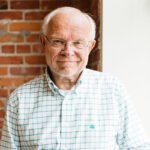
Keith Anderson, D.Min., is a Faculty Associate for Spirituality and Vocation at VantagePoint3 and President Emeritus of Seattle School of Theology and Psychology. He is the author of several books, including his most recent: On Holy Ground: Your Story of Identity, Belonging and Sacred Purpose (Wipf & Stock, 2024). His other works include Reading Your Life’s Story (IVP, 2016), A Spirituality of Listening (IVP, 2016), and Spiritual Mentoring (IVP, 1999). In his writing, teaching, and mentoring, Keith seeks to set a table for people looking to enter the “amazing inner sanctuary of the soul” in the most ordinary and extraordinary moments of life.