

Jesus should have written a book about work-life balance. He didn’t, but he practiced something like it. The Gospels describe his pattern of movement, beginning with his baptism by John.
- He knew who he was because he listened to God tell him, “You are my Son, in whom I am well pleased.”
- From that identity, he moved into a busy ministry of teaching, preaching, healing, and confronting evil.
- And he went off to “lonely places” to pray in solitude.
Spiritually, Jesus seemed to see identity, belonging, learning, worship, and rest as deeply interconnected. Teilhard de Chardin once said, “We are not human beings having a spiritual experience, but spiritual beings having a human experience.”1 If he is onto something, we have been given a caution: do not overspiritualize spirituality. Eugene Peterson also cautioned us to remember that spirituality is primarily about life, life, and more life.
The Human Ways Grace Moves
Trevor Hudson asked the question, “How does grace move through us?” Once again, we look to the ways of Jesus, his practices of receiving nourishment. You will find them more “human” than “spiritual” if you define spiritual as something other than relational, material, or physical.
- He prayed, that is, he disengaged from busyness to engage Abba for the sake of others. Jesus’ relationship with Abba is a case study in listening. He connected with Abba through stillness, silence, and solitude.
- He ate meals at tables open to many kinds of people. One cannot read John 15-17 without seeing how belonging formed him, forms us, and moves us outward toward others.
- He developed a rich relational life: Mary, Martha, Lazarus, Peter, James, John, and both Mary Magdalene and his mother, Mary.
- He participated in serious study of the Torah, the Word of God. “It was his custom to spend time in the synagogue.”
- He participated in worship through covenant rituals, pilgrimages to Jerusalem, and weekly Sabbath.
- He was immersed in Scripture. Great teachers remain students, continually immersed in their own learning.
A Place of Belonging
Many of you are familiar with Rembrandt’s painting, The Return of the Prodigal Son, perhaps because of Henri Nouwen’s experience of seeing it, which he called a picture of homecoming.
“I could not take my eyes away. I felt drawn by the intimacy between the two figures. I saw a man in a warm, red cloak tenderly touching the shoulders of a disheveled boy kneeling before him. But most of all, it was the hands—the old man’s hands–as they touch the boy’s shoulders, that reached me in a place that I had never been reached before. After a self-exposing journey, I was anxious, lonely, restless and very needy; The son-come-home was all I was and all I wanted to be. For so long, I had been going from place to place: confronting, beseeching, admonishing and consoling. Now I desired only to rest safely in a place where I could feel a sense of belonging, a place where I could feel at home.”2
Jesus found time to be alone because there he could connect with his inner being and with Abba. “…human persons have an instinctive and existential ‘reach’ for a transcendent reality.”3 But Jesus lived in community, knowing we are also created with an instinctive and existential reach for human contact. He went to the mountains to find solace, nurture, and the presence of God in nature as well as prayer.
Practice: Where is your quiet, holy place for solitude? Spend a few minutes journaling about this place of belonging, or pray that you will find such a place for yourself.
__________________________________
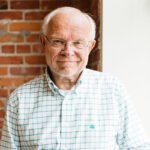
Keith Anderson, D.Min., is a Faculty Associate for Spirituality and Vocation at VantagePoint3 and President Emeritus of Seattle School of Theology and Psychology. He is the author of several books, including his most recent: On Holy Ground: Your Story of Identity, Belonging and Sacred Purpose (Wipf & Stock, 2024). His other works include Reading Your Life’s Story (IVP, 2016), A Spirituality of Listening (IVP, 2016), and Spiritual Mentoring (IVP, 1999). In his writing, teaching, and mentoring, Keith seeks to set a table for people looking to enter the “amazing inner sanctuary of the soul” in the most ordinary and extraordinary moments of life.
1 Ray S. Anderson, Spiritual Caregiving as Secular Sacrament, p. 64.
2 Henri J. M. Nouwen, The Return of the Prodigal Son, pp 4-5.
3 Ray S. Anderson, p. 26.