

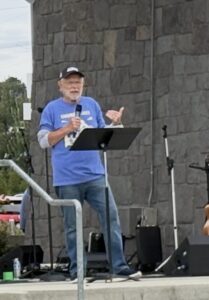
We recently celebrated an event on Whidbey Island called Church for the City. Perhaps as many as 16 churches gathered on the Oak Harbor waterfront at Windjammer Park. It had something of the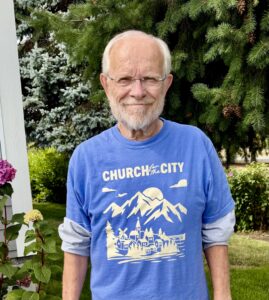 feel of an Old Testament sacred assembly: elders and neighbors gathering the people to worship, sing, serve, and remember God’s movement in the life of their community. More than a thousand of us came for worship, a day of service to our city, and a shared communion service. And, by the way, I got a T-shirt.
Our day called to mind Jeremiah’s letter to the exiles in Babylon:
“But seek the welfare of the city where I have sent you into exile, and pray to the Lord on its behalf, for in its welfare you will find your welfare” (Jeremiah 29:7).
The word translated welfare is the Hebrew word shalom – peace, wholeness, well-being, thriving, and resilience. The repetition matters: seek the city’s shalom, because in its shalom you will find your shalom. This was not a letter to people who had freely relocated after looking up housing options on Redfin. They had been carried into exile after defeat by a mighty military empire. Jeremiah’s instructions were not merely surprising; they must have been terribly upsetting.
Jeremiah tells them to build houses, plant gardens, raise families, grow there, and pray for the city that now holds them. This is not an endorsement of Babylon’s gods or brutality, nor is it a call to lose their identity. It is a summons to faithful presence: remain God’s people, but refuse to make withdrawal, resentment, or revenge your mission.
Shalom is never private property. It is a shared ecology of wholeness.
I can hear the murmurs as God’s people read the scroll of Jeremiah’s letter. A prophetic word from Yahweh? Imagine hearing this at a school board or HOA meeting: “Can you believe it? God wants us to pray for our city? God wants us to settle in, build houses, plant gardens, and learn to live with respect for our neighbors and our new community. Has God forgotten that these people are our enemies? We are here because we lost the war. Our strategy should be to isolate ourselves from their pagan gods and wicked ways. We should withdraw and build our own community. Why should we become involved in the shalom of Babylon?” They might even have said, “Israel first and Israel only. Let the Babylonians take care of their own problems.”
But Jeremiah is clear: this is a word from God. We still need to ask whether it belonged only to one narrow moment in Israel’s history. Jeremiah 29:7 is not the text Jesus read in his hometown synagogue, and we should not pretend that it is. Yet Jesus stands firmly within the same prophetic tradition. In Luke 4:18-19, he reads Isaiah 61:1-2, with an echo of Isaiah 58:6, and announces good news for the poor, release for captives, sight for the blind, freedom for the oppressed, and the year of the Lord’s favor. He then reminds Nazareth that God’s mercy reached a widow in Sidon and Naaman the Syrian. The people understood the uncomfortable implication: God’s concern does not stop at the borders of our familiarity.
The gospel does not ask whether Babylon deserves our prayers; it asks whether we will seek the good of the place where God has placed us.
If that is accurate, God would still say today: the church is for the city. The church is not simply, or coincidentally, in the city, but intentionally for the city. This calling does not depend on the size, influence, strategic economic value, or renown of your town, village, or city. It does not matter whether you live in New York City, Sioux Falls, or Nisswa, Minnesota. When the church understands God’s intention, this deeply embedded truth changes how it sees its neighbors and itself.
The church is not merely located in a city; it is called to become good news for that city.
It Grounds the Church in the Local
I grew up in a church with deep roots in what we then called foreign missions: the Congo, Ivory Coast, Portugal, Ceylon, India. We learned to look across oceans, and there was much that was faithful in that vision. But when a neighboring congregation in inner-city Chicago found itself amid the riots of the 1960s following the assassination of Dr. Martin Luther King Jr., I fear we looked the other way. The violence and cultural rage were more than we could comprehend, and our incomprehension became distance. We cared about places far away while struggling to see the pain close by.
Faithful presence is love with a local address.
There are days I wonder what lies ahead for my grandchildren. Will today’s political divisiveness and vitriolic disrespect find a way “back,” or forward? Will we unite around shared values and trusted common understandings of facts and events, or are today’s culture wars simply the new norm? I have lived through divisions in our nation—battles over Vietnam, Civil Rights, Women’s Rights, Sexual ethics and so much more. I am familiar with our divisiveness; I am more uncertain today than ever before about healing and uniting. But I have come to wonder: is it possible that healing the bitter political divisions in our nation may depend, at least in part, on how we live with one another in local neighborhoods and communities – among people whose faces we can see and whose stories we might actually know? We cannot seem to find ways to be respectful, united, or mutually concerned at the state or national level. Perhaps one part of the answer will come from Jeremiah’s letter to Israel in Babylon: seek the shalom of the place where you are.
Local love may be one of God’s most durable answers to national division.
It Grounds the Mission of the Church in Care for the City
Listen again to the Old Testament texts that give shape to Jesus’ public ministry. Isaiah 61 begins, “The spirit of the Lord God is upon me, because the Lord has anointed me.” The prophet is sent to bring good news to the oppressed, bind up the brokenhearted, proclaim liberty to captives, announce the Lord’s favor, and comfort those who mourn. Isaiah then turns from comfort to public restoration:
“They shall build up the ancient ruins, they shall raise up the former devastations; they shall repair the ruined cities, the devastations of many generations” (Isaiah 61:4).
Luke’s account adds an important detail. When Jesus reads Isaiah 61 in Nazareth, he stops before the phrase “the day of vengeance of our God.” Luke places the accent on grace, release, and the Lord’s favor. Jesus does not erase judgment from Scripture, but his inaugural announcement makes unmistakably clear what his Spirit-anointed ministry is bringing near.
The same theme appears earlier in Isaiah:
“Your ancient ruins shall be rebuilt; you shall raise up the foundations of many generations; you shall be called the repairer of the breach, the restorer of streets to live in” (Isaiah 58:12).
And Proverbs 11:10-11 adds a wisdom perspective:
“When it goes well with the righteous, the city rejoices; and when the wicked perish, there is jubilation. By the blessing of the upright a city is exalted, but it is overthrown by the mouth of the wicked.”
The proverb is not permission to celebrate cruelty. It is a sober claim that character has public consequences. Righteousness blesses more than the righteous person; destructive speech damages more than the speaker. A city’s life can be lifted by the integrity of its people or torn down by the words they release into the common life.
I invite you to ponder each of these texts as you think about your own community. The church learns, as ancient Israel had to learn, that its well-being is bound to the well-being of its neighbors. Jeremiah’s conclusion is stunning: “In its welfare you will find your welfare.” Your shalom is aligned with the shalom of the city. A congregation may increase its attendance, budget, or influence while the community around it collapses, but that is not flourishing in the biblical sense. Biblical shalom is larger than institutional success.
 A church may grow in attendance and still fail to grow in love for its city.
Perhaps the guiding questions are these: What would it look like for our city to flourish because we are here? How can we bring blessing rather than hostility, engagement rather than withdrawal, repair rather than accusation? The presence of God’s people is meant to be a gift to the community – not because the church is the city’s savior, but because the church bears witness to the Savior through faithful presence and active care.
In our church in Pontiac, Michigan, we created a program simply called Operation Sunshine. It was a summer program for children on Pontiac’s west side, where no such program existed. We offered what the city could not provide at that time. At least for those summers, there was a small flourishing of opportunity, care, safety, and joy for the children of our city. It did not solve everything. It was simply one way of saying, “Because we are here, we want this neighborhood to be more whole.”
The city, especially in a large metropolitan area, is often described as hostile territory or an adversarial environment. The response is too often withdrawal when God intends blessing. Jeremiah calls God’s people to become proactively part of the city’s life. Their goal is not merely to tolerate Babylon until they are freed, but to seek its shalom without surrendering their identity to Babylon.
The church is not sent to win a battle against the city, but to seek the good of the city.
What might that look like? It might include:
- Commitments to how children are protected, nurtured, and given room to flourish.
- Safe neighborhoods in which people can live without fear.
- Businesses that provide what the community truly needs and treat workers and customers with dignity.
- The flourishing of art, beauty, and places that awaken hope.
- Schools, health care, and civic institutions that become healthier and more trustworthy.
- A welcome for the stranger in the land – including immigrants who are treated as neighbors rather than abstractions.
While perusing information about artificial intelligence, I came across this sentence: “The church loves the city without requiring the city to love the church back.” If a bot can understand that, so should we.
The church loves the city without requiring the city to love the church back.
A Practice for the Church
Ask your community before assuming you already know: Where is our city wounded? Where is it alive? What do our neighbors fear, hope for, and need? Then ask your congregation: How might we join God in seeking the city’s wholeness? How can we repair what is broken, rebuild what is neglected, make peace within communities, and practice shalom?
The city is not a ministry project to be managed; it is a community of neighbors to be loved.
Begin with prayer, but do not stop there. Walk the streets. Sit with a teacher, a nurse, a business owner, a social worker, an immigrant neighbor, a teenager, or a weary parent. Ask where life is breaking down and where blessing is already appearing. The church does not enter that conversation as the hero with every answer. It enters as a neighbor ready to listen, serve, and join the good work God is already nurturing.
The church does not make the city whole by its own power. It becomes a sign of God’s wholeness by showing up, listening well, repairing breaches, welcoming strangers, and practicing peace. Jeremiah’s prophetic word is both simple and demanding: seek the shalom of the place where God has sent you. Remember, the people of God are not merely meant to be a church in the city. We are called to be a church for the city.
__________________________________

Keith Anderson, D.Min., is a Faculty Associate for Spirituality and Vocation at VantagePoint3 and President Emeritus of Seattle School of Theology and Psychology. He is the author of several books, including his most recent: On Holy Ground: Your Story of Identity, Belonging and Sacred Purpose (Wipf & Stock, 2024). His other works include Reading Your Life’s Story (IVP, 2016), A Spirituality of Listening (IVP, 2016), and Spiritual Mentoring (IVP, 1999). In his writing, teaching, and mentoring, Keith seeks to set a table for people looking to enter the “amazing inner sanctuary of the soul” in the most ordinary and extraordinary moments of life.
1 Comment
This is an inspiration for us to apply to our church!