

The calls started coming about a month ago. “Jerry is having trouble breathing; they’ve taken him to the hospital for oxygen.” Jerry is my older brother. During the late stages of pregnancy, my mother experienced complications that caused the loss of oxygen flow to his brain, resulting in life-altering mental capacities for him. He was what we might call today “mentally challenged,” what people cruelly called then “retarded.” He was, in other words, a survivor of a birth-related brain injury.
In truth, his abilities were challenged, causing him to be placed in the “special” class and mainstreamed in public education in suburban Chicago. It was a class comprised of many people with various forms of disability, only to be ridiculed because they might not be articulate in speech, might laugh at the wrong time, be unable to complete sentences, drool, or have bodies with spastic motions at unexpected moments. Because they were “special,” they were often treated badly on the playground, in the hallways, or just walking with us through town; mothers even “protected” their own children when they saw Jerry and me walking the sidewalks. More than once I even told mothers to “shut up,” as they called him “retard.” “Shut up” was a phrase not allowed in our family home.
Jerry was a special needs child. His life changed within only a few months of what appeared to be an otherwise normal pregnancy. Until age 16, he was in the public school system, but nothing was offered beyond that age. Eventually, he moved to a group facility in southern Illinois where he lived just short of 50 years.
A “special needs” brother
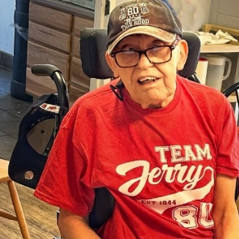 What was it like growing up with a “special” brother? Hard at times, joyful at others. He would have been a stud athlete—tall, coordinated, and strong. He had my father’s sense of humor and a twinkle in his eyes as he was teased or teased himself. He loved his family—three sisters and his only brother—me. And, yes, he could be a challenge for my mother with five children. A special-needs child never grows up alone; the whole family grows around that one life—its wounds, its gifts, its laughter, and its love. And, as one voice, we would all say, “Jerry’s love blessed us, each one.”
In July, his breathing got worse, pneumonia took over, and Jerry died on July 7. My sister, Karla, and brother-in-law, Bruce, were there to walk with him in the final hours of his life, painfully at moments to be sure, but cared for by hospice in the end. She sang with him, prayed with him, and did what she always did: blew kisses to him as her gesture of love.
 If you asked him what he wanted for Christmas or his birthday, he would consistently say, “Well, I need a watch.” Karla found 10 watches in his drawer. “I’d like to have a cross.” She found crosses of various kinds. “Well, I’d like to have a ring.” There were many rings in a drawer. Apparently, we all answered his requests without coordinating with our siblings.
All four of the siblings experienced our own challenges as we grew to adulthood while he, somehow, remained a bit of a child in a man’s body. I return again and again to two immigrant families’ children, my young mother and father in 1944. Their first-born was Jerry. It took just a short while to realize his birth trauma was permanent; their heartache would be lifelong. If you can, imagine all the dreams wrapped up with the pregnancy of your first child only to be dashed in the words of the doctor.
There are shadows of darkness that come to every life. Some are fleeting, like a burst of sunlight that flashes across a room followed by clouds. Some last a lifetime of sadness, disappointment, and heartbreak felt most intensely by those with broken dreams. And yet… Jerry also brought love, humor, joy, and happiness to our family. There were challenging times, of course. Moments when his emotions and body were less in control. Moments when his physical development made him tall and strong and less easy to direct toward proper behavior.
We were a church family, present, I think, every time the doors were unlocked (or did we have our own set of keys)? Jerry was surrounded by worship, loving church members, hymns, and scripture. So, even in his limited capacity and inadequate mental abilities, Jesus showed Jerry his true identity, and Jerry could say it, sing it, and confess it in childlike conviction. Jesus loves me, this I know. Jerry’s faith was childlike not because it was shallow; he became a man of deep trust in Jesus. He was dearly loved at Beverly Farm where he lived all those years. Karla’s description was apt: “I love each of you…may each of you grieve as is your way and remember the sweet, kind Bible-carrying man (with many watches) who would want to listen to you, give you a hug or throw a kiss, Arthur Jerald Anderson.”
To be whole
Many tears have been shed and will continue for each of us, as his siblings. But the moment of levity and truth came from an auto-correct email from my older sister, Judy. When we thought of his possible passing from pneumonia, we agreed: we wanted him to be whole. I wrote earlier that I longed for him to be whole in ways he had never been…yet. Judy said the same and then said that, “Jerry was now rejoicing with our parents.” But autocorrect apparently lacks spirituality and said instead, “Jerry was now rehousing…”
That’s when autocorrect got theology right. You can call it sentimentality. You can tell me it’s the convenient message of the church to make people feel good at times of death. “Well, you’ll go to heaven, you’ll rejoin family, you’ll be restored.” You can discount biblical teachings as you must, I suppose, but it is the clearest, most definitive declaration we find in the New Testament.
Jesus said to her, “I am the resurrection and the life. The one who believes in me will live, even though they die.” – John 11:25
Praise be to the God and Father of our Lord Jesus Christ! In his great mercy he has given us new birth into a living hope through the resurrection of Jesus Christ from the dead, – I Peter 1:3
I want to know Christ—yes, to know the power of His resurrection and participation in his sufferings, becoming like him in his death, – Philippians 3:10:
We were therefore buried with him through baptism into death in order that, just as Christ was raised from the dead through the glory of the Father, we too may live a new life. – Romans 6:4
It is my hope. It is my confidence. It is my faith. In Christ, we will know the power of his resurrection and wake one day to resurrected bodies and minds, restored, whole, strong as they never might have been. We will find a new home in the presence of God our loving Father, Jesus our Savior and Lord, and the Holy Spirit. Resurrection is not an escape from the life we have lived; it is that life, rehoused by God—healed, completed, made whole.
And yes, I live in the confident faith that Jerry is now being rehoused and will wait for those who loved him to welcome us to our new homes in eternity. Glory be to God.
__________________________________

Keith Anderson, D.Min., is a Faculty Associate for Spirituality and Vocation at VantagePoint3 and President Emeritus of Seattle School of Theology and Psychology. He is the author of several books, including his most recent: On Holy Ground: Your Story of Identity, Belonging and Sacred Purpose (Wipf & Stock, 2024). His other works include Reading Your Life’s Story (IVP, 2016), A Spirituality of Listening (IVP, 2016), and Spiritual Mentoring (IVP, 1999). In his writing, teaching, and mentoring, Keith seeks to set a table for people looking to enter the “amazing inner sanctuary of the soul” in the most ordinary and extraordinary moments of life.