

I lift up my eyes to the hills—
from where will my help come?
My help comes from the Lord,
who made heaven and earth.Psalm 121:1-2
What are you looking at?
It is an ordinary question—one you ask when a friend suddenly pauses, their attention caught by something you cannot yet see, or when a passenger turns to look back along the highway. We ask, “What are you looking at?” Common, yes, but it may be one of the important spiritual questions with which to begin a day: What will claim my attention in the hours ahead? It is a question to be asked by all of us.
For ministry leaders, the question carries particular urgency. Our eyes are trained to notice what needs attention: the unfinished sermon, the struggling congregation, the conflict that will not resolve, the call still unreturned, the budget, the building, the meeting, the grief beneath someone’s composed face. Much of ministry is the holy work of looking closely at what stands before us. But over time, faithful attention can harden into the weary habit of staring only at what is wrong. For the rest of us, we know the busyness that distracts during a typical day of work, groceries, the gas station, bill paying, and dinner preparation.
Attention is never merely optical. What holds our gaze eventually lays claim to our imagination, emotions, dreams, and hope.
The Holy Ground Beneath Our Feet
I have written before about the importance of looking down—at the ground beneath our feet, the actual places through which we make our way. There is holy ground immediately under us: the neighborhood where we live, the path we walk, the rooms in which we serve, the people we notice or fail to notice as we hurry past. Looking down keeps us grounded-pun intended-in the place God has given us to inhabit.
Walking with our heads lowered can itself become a spiritual exercise when it means paying attention: noticing soil and sidewalk, the overlooked person, ordinary beauty, evidence of suffering, and quiet signs of grace. Ministry becomes abstract and disembodied when we stop attending to real ground and real people. Jesus was never too “spiritual” to notice the one beside the road, the woman who touched his garment, the man in the tree, or the sufferer waiting thirty-eight years by the pool.
So, this is not an argument against looking down. Faithful ministry requires attention to the ground. But the soul needs a complementary movement as well. Sometimes we must join the psalmist and look up.
A Pilgrim Song for the Weary
Psalm 121 begins simply: “I lift up my eyes to the hills.” It is one of fifteen Songs of Ascents; psalms associated with Israel’s pilgrimage to Jerusalem. The city sits high in the Judean hills, and pilgrims traveled upward toward the Temple Mount for Passover, Pentecost, and Tabernacles. This song belonged both to the road and to worship–to people making an actual ascent and to souls turning again toward God.
Imagine these pilgrims on their journey: walking, tired feet, dangerous roads, vulnerable families, and miles still ahead. Then, somewhere on the journey, the hills of Jerusalem come into view. The pilgrims lift their eyes. What rises before them is not an escape from the road, but a reminder of where the road is leading. The upward look gives direction to the next faithful step.
Perhaps the psalmist is saying: Look above the circumstances that have bent your head toward despair. Look toward beauty, glory, worship, and wonder. Look toward the place where voice, hands, and heart will again be gathered into praise. Look at the mountain and remember that God is present in your world, even when fatigue has narrowed your vision.
Then the psalmist asks the question every one of us asks, either aloud or in the hidden sanctuary of the heart: “From where will my help come?”
The answer comes at once: “My help comes from the LORD, who made heaven and earth.” Help does not come from the hills themselves, from a stronger personality, a better technique, a larger platform, or our heroic capacity to hold everything together. It comes from the creator, from One whose care we all need each day.
The God Who Keeps Us
The rest of Psalm 121 turns on one recurring promise: the Lord keeps. God will not let your foot be moved. The One who keeps you will not slumber. The keeper of Israel neither slumbers nor sleeps. The Lord is your keeper and your shade at your right hand. The sun will not strike you by day, nor the moon by night. The Lord will keep you from evil; the Lord will keep your life. The Lord will keep your going out and your coming in, from this time on and forevermore.
The psalm does not promise that pilgrims will never grow tired, that leaders will never be wounded, or that faithful people will never walk dangerous roads. It promises that our lives are held within the wakeful attention of God. We may lose sleep because of the church; God does not lose sight of us. We may not know how to keep everything entrusted to us; we remain among those whom God keeps. God guards, protects, and preserves us-and keeps us from what would finally destroy us. Watch for that today: How might God keep you, and what might God keep you from, in your going out and your coming in?
That may be the first spiritual gift of lifting our eyes: we remember that we alone are not the keepers of the world. God is. We are stewards, servants, pastors, teachers, and companions-but not saviors. Looking up restores the proper scale of things. The problems before us remain real, but they no longer fill the whole horizon.
When the Soul’s Horizon Narrows
I have been reading Howard Thurman-the African American pastor, professor, chaplain, mystic, and spiritual guide whose inward life helped sustain leaders of the civil rights movement. Thurman understood how easily the soul’s horizon shrinks until the details of one’s own life occupy the entire field of vision. In a meditation titled “I Will Lift Mine Eyes,” he wrote:
Scarcely knowing it, I have become increasingly self-centered, my mind focused upon all the details of my little life and the endless trivialities of a daily routine. I hover over all my little aches and pains, my petty annoyances, my little frustrations, while the band around my head tightens and tightens until at last, I would despair completely… Then out of no place comes, sometimes a gentle, sometimes a startling reminder, and I lift up my eyes.1
Thurman names something ministry leaders know well. The tightening band may be made of responsibilities rather than trivialities, but the effect can be the same. Our interior world contracts. We hover over every disappointment, replay every criticism, measure every absence, and carry every need as though it were ours alone to resolve. A calling once filled with wonder is reduced to a list of burdens.
Then comes a reminder: a story of courage, a long-forgotten melody, a telephone call, a human need beyond the borders of our preoccupation. Something breaks open the closed circle of the self; we remember that we are not the keepers, and we lift our eyes.
What We Receive When We Look Up
To lift our eyes is not to deny pain, abandon responsibility, or reduce hard realities with easy optimism. It is to place those realities within a larger field of vision. That movement offers several gifts.
First, lifting our eyes restores perspective. What is close can feel confining. A conflict, a failure, or a season of decline can fill the frame. Looking toward the hills reminds us that this difficulty belongs to a longer pilgrimage; it is not the final landscape.
Second, lifting our eyes reawakens dependence. “My help comes from the LORD” is both confession and release. It breaks the illusion that faithfulness means being sufficient for every demand. We live best when we know where help comes from.
Third, lifting our eyes interrupts self-absorption. Thurman is unsparing about how readily the gaze turns inward. Looking up reopens the soul to another person’s courage, another person’s cry, another person’s need. It returns us to love.
Fourth, lifting our eyes enlarges hope. Hope is not a denial of the road beneath us; it is the capacity to see a destination beyond the next difficult mile. The hills tell the pilgrim that the journey is going somewhere, that God’s presence is, in fact, near.
Finally, lifting our eyes renews worship. Our lives can become so occupied that we forget our need, each one, to encounter God. The upward gaze returns us from managing busy things to beholding the Holy One.
Eyes Lifted to Life, Love, and God
Thurman concludes his meditation with a threefold lifting of the eyes:
I will lift up mine eyes to life, that I may read the guideposts along my way and not miss the important turning in the road. I will lift up mine eyes to love, that I may not close the door of my heart to the knocking hand, the tender cry, the anxious reach. I will lift up mine eyes to God, that I may meet his spirit not only in the high place, the great moment, the penetrating call, but also in the byways, the little duties, the stinging irritations, and the sad and bottomless renunciations. And for me this is enough.2
Life. Love. God. These are not three separate directions; they belong together. We lift our eyes to God and are sent back to life with clearer sight. We lift our eyes to life and begin to recognize the guideposts of grace. We lift our eyes to love and see the knocking hand, the tender cry, the anxious reach we had nearly overlooked.
And, in a beautiful reversal, lifting our eyes teaches us how to look down again-at the holy ground beneath our feet, the person before us, the next ordinary duty-with less resentment and more reverence. We do not look up in order to leave the world. We look up in order to return to it with a larger heart.
Eugene Peterson doesn’t want us to do this work alone.
We can take note of men and women who have done this well and keep company with them. We can see how they have done it, hoping to get the hang of it ourselves so that we will live well, live completely, live in great love with the people around us, and live in great faith in God.
We can look for lives worth watching. We can look for those who did this well, who lived in love and lived in faith. We can look for those who leave little unlived life around them, who can show us what is possible for ourselves, and who can whet our appetites for the best—the human best.
The Christ best.3
A Practice for the Beginning of the Day
I was teaching a Doctor of Ministry class recently. Instead of beginning with a conventional “devotional,” I asked the students to stand near a window and look down, out, and up. Then I read 1 John 1: 1-5 as an invitation to focus, notice, pay attention, listen, and touch. All of it is physical. Spirituality is not vacuous, not like a morning mist. In prayer we speak and listen. In worship we sing and feel. In Scripture study we read and think. Our bodies are engaged.
Before opening your email, reviewing the calendar, or rehearsing the problems waiting for you, step outside or stand at a window. Let your body participate in the prayer. Raise your head. Look toward the farthest point you can see. Breathe slowly, and ask:
- What has narrowed my field of vision?
- From where am I expecting help to come?
- Whom might I see differently if I received, again, the keeping care of God?
Then pray the words of the pilgrim: “I lift up my eyes to the hills-from where will my help come? My help comes from the LORD, who made heaven and earth.”
Some days, lifting your eyes will feel like worship. Other days it will feel like resistance—a refusal to let discouragement, urgency, or self-importance define the whole horizon. Either way, it is a small bodily act of faith.
The work will still be there when you lower your eyes. The road will still need to be walked. But perhaps you will see it differently. You are not walking toward emptiness. You are walking beneath the gaze of the God who does not sleep, held by the One who keeps your going out and your coming in, from this time on and forevermore.
Lift up your eyes. Your help is nearer—and your world is larger—than weariness has allowed you to see.
__________________________________
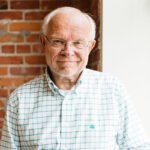
Keith Anderson, D.Min., is a Faculty Associate for Spirituality and Vocation at VantagePoint3 and President Emeritus of Seattle School of Theology and Psychology. He is the author of several books, including his most recent: On Holy Ground: Your Story of Identity, Belonging and Sacred Purpose (Wipf & Stock, 2024). His other works include Reading Your Life’s Story (IVP, 2016), A Spirituality of Listening (IVP, 2016), and Spiritual Mentoring (IVP, 1999). In his writing, teaching, and mentoring, Keith seeks to set a table for people looking to enter the “amazing inner sanctuary of the soul” in the most ordinary and extraordinary moments of life.
1 Howard Thurman, Meditations of the Heart, “I Will Lift up Mine Eyes,” pp 160-161.
2 Thurman, Meditations of the Heart, pp 160-161.
3 Eugene Peterson, On Living Well, p. xxi.